Browse by Tags: llas
 | Up a level |
Number of items: 18.
Preview |
![[img]](http://www.humbox.ac.uk//style/images/fileicons/text.png)
Discussion Board: Socioeconomic and demographic reality of Contemporary Spain
Shared with the World by Mr Antonio Martínez-Arboleda
This activity is currently being used in the module SPPO 2650/1 "The Spanish regional Melting Pot: the old same History?" at the University of Leeds. Students make their contributions via discussion boards in VLE Blackboard.
The activity is aimed at facilitating students’ interaction and co-operation in the process of understanding the complex socio-economic and demographic reality of Spain and its Autonomous Communities as well as the country’s political-territorial structure. It also fosters transferable skills such as statistical literacy, the ability to work as part of a group, negotiating skills, communication skills, leadership and spirit of enquiry.
The activity was first used in the module "Spain: Political Decentralisation and Integration into Europe" (SPPO 2370/1) in 2008 but has been updated since them. It can be downloaded either as a word document or as a pdf. Last update 29 September 2014.
Shared with the World by Mr Antonio Martínez-Arboleda
Preview |
Emergency Lesson Planning Using Humbox
Shared with the World by Dr Sarah Hayes
This sheet is designed for use with the following items
Powerpoint called Learning Not to Plagiarise Using 'Turnitin’ and ‘Humbox’
Sarah Hayes
Video demonstrating plagiarism detection using the Turn It In online service with thanks to the creator: Mr Robert Toole
Examples of plagiarism:in Archaeology
Referencing & Bibliographies - Learning Unit 5 with thanks to the creator: Mr Brett Lucas
Shared with the World by Dr Sarah Hayes
Preview |
LLAS and open practice: an overview
Shared with the World by Ms Kate Borthwick
This powerpoint was given by Kate Borthwick and Alison Dickens at an HEA OER workshop, on 7th November, 2012, at the University of Southampton. It outlines the work of LLAS and the language educator community in the area of open practice, and describes an evolution from a focus on technical issues to benefits of open practice, to open research and students-as-producers of open content.
Shared with the World by Ms Kate Borthwick
Preview |
Preview |
OpenLIVES Pedagogy
Shared with the World by Mr Antonio Martínez-Arboleda
This is a document, uploaded as a PDF and as a ppt, outlining the main points of the presentation given at the HEA-funded OpenLIVES workshop at the University of Southampton (LLAS) on the 23rd of May 2012. During the presentation some educational principles and practices emerging from the OpenLIVES experience were discussed, including the idea of student as an author and transacademic life skills. This presentation is the basis for the second part of the OpenLIVES presentation of the July 2012 LLAS Symposium in Edinburgh given in conjunction with Kate Borthwick, from LLAS in Southampton.
Shared with the World by Mr Antonio Martínez-Arboleda
![[img]](http://www.humbox.ac.uk//style/images/fileicons/audio.png)
OpenLIVES Spanish emigre interviews - Anonimo 2
Shared with the World by Ms Kate Borthwick
This is the raw, unedited footage of an interview with a Spanish emigre, who wishes to remain anonymous. It was conducted by Darren Paffey, of the University of Southampton, on 10th June, 2008. It is in Spanish and is 2 hours 42 minutes long. This work is licensed under the Creative Commons Attribution Non Commercial License http://creativecommons.org/licenses/by-nc/3.0/. This means that you may download and adapt the work for non-commercial purposes but you must credit the original author. All use and versions of this material should be attributed. Please cite this work as: OpenLIVES project (2012). An open collection of research data and teaching materials relating to Spanish migrant stories. JISC
Shared with the World by Ms Kate Borthwick
![[img]](http://www.humbox.ac.uk//style/images/fileicons/video.png)
![[img]](http://www.humbox.ac.uk//199/2/composite.jpg)
Polynomial Texture Mapping
Shared with the University by Dr Fiona Handley
This resource consists of a short video demonstrating the use of a polynomial texture mapping rig, recording the surface features of a piece of inscribed stone, and an image which shows the how the different lighting sources and PTM software highlight tiny details in the stone surface.
Shared with the University by Dr Fiona Handley
![[img]](http://www.humbox.ac.uk//1457/1/composite.jpg)
 Preview |
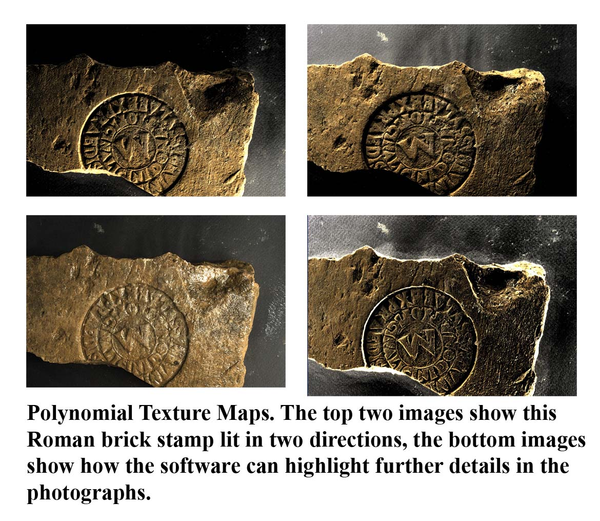
Polynomial Texture Mapping - Examples of image results
Shared with the World by Dr Fiona Handley
These four images show how the same digital data set collected through polynomial texture mapping, can be modified in the PTM software to highlight different details in the lettering and surface texture on this Roman brick stamp.
Shared with the World by Dr Fiona Handley
Preview |
Portus Exhibition 2
Shared with the World by Dr Fiona Handley
A panel from an exhibition held at Southampton Museum and the British School at Rome on the University of Southampton's Portus project
Shared with the World by Dr Fiona Handley
Preview |
Portus Exhibition 3
Shared with the World by Dr Fiona Handley
A panel from an exhibition held at Southampton Museum and the British School at Rome on the University of Southampton's Portus project.
Shared with the World by Dr Fiona Handley
Preview |
Portus Exhibition 4
Shared with the World by Dr Fiona Handley
A panel from an exhibition held at Southampton Museum and the British School at Rome on the University of Southampton's Portus project.
Shared with the World by Dr Fiona Handley
Preview |
Portus Exhibition 5
Shared with the World by Dr Fiona Handley
A panel from an exhibition held at Southampton Museum and the British School at Rome on the University of Southampton's Portus project
Shared with the World by Dr Fiona Handley
Preview |
Portus Exhibition 6
Shared with the World by Dr Fiona Handley
A panel from an exhibition held at Southampton Museum and the British School at Rome on the University of Southampton's Portus project
Shared with the World by Dr Fiona Handley
Preview |
Portus Exhibition 7
Shared with the World by Dr Fiona Handley
A panel from an exhibition held at Southampton Museum and the British School at Rome on the University of Southampton's Portus project
Shared with the World by Dr Fiona Handley
Preview |
Publication and collaboration : publishing open research data and creating teaching resources
Shared with the World by Ms Kate Borthwick
This presentation was given by Alicia Pozo-Gutierrez and Irina Nelson at the 7th annual LLAS elearning symposium, 27th January, 2012. It describes the work of the JISC OpenLIVES project which plans to publish research data as open content, then create and embed OERs relating to that content into teaching.
Shared with the World by Ms Kate Borthwick

Role plays and simulations for modules on Spanish politics and society
Shared with the World by Mr Antonio Martínez-Arboleda
Collection of collaborative activities for the module SPPO2650/1 "The Spanish Regional Melting Pot: The Same Old History?" (formerly "Spain: Political Decentralisation and Integration in Europe", taught at the University of Leeds in all the BAs in Spanish. These activities, which are ideal for online discussion boards or simply seminar-group work, are also suitable for many other modules on Spanish Society, Spanish Politics and Spanish Economy. They all have been tried and tested with students and have received positive feedback. For more information please see Martínez-Arboleda, A. (2009) "Using new technologies on content modules in modern languages", Liaison. July 2009. 29-31.
Shared with the World by Mr Antonio Martínez-Arboleda
Preview |
Using, developing and sharing resources
Shared with the World by Ms Kate Borthwick
These are the slides from a presentation I gave at the LLAS annual event for new staff in languages, linguistics and area studies, on 15th April, 2011. The event was held at Jesus College, University of Oxford.
Shared with the World by Ms Kate Borthwick
Preview |
Using, developing and sharing teaching resources
Shared with the World by Ms Kate Borthwick
I gave this presentation at the LLAS event for new staff 'Life and work in Academia,' 12th April, 2012, at Aston University. It gives an introduction into concepts of open educational resources and why engaging with openness is a good thing.
Shared with the World by Ms Kate Borthwick
Video Exavating and processing archaeological objects at the Roman site of Portus
Shared with the University by Dr Fiona Handley
A short video covering the excavation of objects, showing bags of environmental samples, and the sorting and processing of finds from the Roman site of Portus in Italy.
Shared with the University by Dr Fiona Handley


