Browse by Tags: employability
 | Up a level |
Number of items: 18.
Preview |
Preview |
Collaborative Online Assignments for Final Year Module on Literature
Shared with the World by Mr Antonio Martínez-Arboleda
This is an alternative untested methodological proposal for a Literature Module that was taught for several years at the University of Leeds following the traditional lecture-seminar-essay methodology. This alternative methodology embeds very prominently team work, organisational skills, public communication skills and learners' initiative and leadership, whilst reinforcing classic academic skills such as critical thinking by making content more attractive as a result of the various ways in which social engagement occurs. There are almost no limitations to the successful introduction of any kind of e-learning tools such as discussion boards, wikis and podcasts in any literature module that follows socio-constructive approaches. Thanks to my colleague Dr David Frier, who used to teach the module "Innovation and Experimentation in Portuguese 20th Century Literature", for his help. For information and reflections on this methodology, please see A. Martínez-Arboleda, "Using new technologies on content modules in modern languages", Liaison, Issue 3, 2009, págs. 29-31. http://www.llas.ac.uk/news/newsletter.html
Shared with the World by Mr Antonio Martínez-Arboleda
Preview |
Preview |
Designing an English degree programme
Shared with the World by Mr Brett Lucas
There are three types of activities, appropriate for English lecturers working in groups or as individuals, in this resource. Their topics are employability, transition from A level, and getting the ‘delicate balance’ right between literature, language and Creative Writing when designing an English programme for today’s students. These activities rely in part on an interview with Professor Marion Wynne-Davies (University of Surrey). As Head of Department, Wynne-Davies shares the ideas and strategies she followed to launch the Surrey English degree programme in 2008.
Shared with the World by Mr Brett Lucas
Preview |
Preview |
Discussion Board: TV documentary on national identity in contemporary Spain
Shared with the World by Mr Antonio Martínez-Arboleda
This activity is currently being used in the module SPPO 2650 "The Spanish regional Melting Pot: the same old History?" at the University of Leeds. This module is a Level 2 very popular option for all our BAs in Spanish. Students make their contributions via discussion boards in VLE Blackboard. The activity was first used in the module "Spain: Political Decentralisation and Integration into Europe" (SPPO 2370/1) in 2009 but has been updated since them. It is aimed at facilitating students’ interaction and co-operation in the process of understanding national and regional identities in contemporary Spain. It fosters transferable skills such as intercultural communication, analytical skills, critical skills, the ability to work as part of a group, commercial awareness, negotiating skills, online communication skills, leadership and spirit of enquiry. The activity also offers students the possibility to reflect upon ethics and responsibility in a research and communication professional role. It contains a word document with the activitiy in Spanish for 2012-2013, a word document with a learning reflection sheet to do in the classroom after the activity (this was incorporated in response to feedback received from employer) plus previous versions of the activity in Spanish and English.
Shared with the World by Mr Antonio Martínez-Arboleda
Preview |
Employability Tutorials
Shared with the World by Dr Mel Prideaux
Simple tutorial/seminar plan to facilitate conversation with level 3 students about their career plans.
Shared with the World by Dr Mel Prideaux
Preview |
Employability action plan
Shared with the World by Dr John Canning
I used this with postgrade students in conjuction with an adaptation of the ESECT card sort.
Shared with the World by Dr John Canning
![[img]](http://www.humbox.ac.uk//style/images/fileicons/text.png)
IEREST Module 3 - Student mobility beyond the academy
Shared with the World by Ana Beaven
The purpose of this activity is to have students address the question “What have I got from my Erasmus experience that is not strictly related to my academic career?”. Specifically, this breaks down into two broad foci. The first two tasks concern the theme of citizenship, and ask students to reflect on how they may view themselves as global citizens as a result of their study abroad, and on what European citizenship may mean to them. The second theme revolves around how mobility is perceived in the professional world, what skills the students have acquired from the Erasmus experience, and how they can communicate those gains to future employers.
Shared with the World by Ana Beaven
Preview |
Langsnap 3: Working Abroad (Preparation for ML students)
Shared with the World by Dr L. Patricia Romero de Mills
The key objective of the Langsnap Guides is to provide resources and materials for programme administrators and for study abroad participants. Guide 3 focuses on preparing students for a period of residence abroad spent working in an unfamiliar environment. It covers the following aspects:
a) Reflecting on the potential of this option, and managing expectations.
b) Unexpected outcomes, including negotiating extra working hours, and
the sudden termination of a contract.
c) The value of the year abroad for future employment.
d) Dealing with emotions related to this aspect of their experience.
A suggested lesson plan for this guide is provided in the "notes" section of the Power Point.
Note: You are welcomed to download and edit the materials in any way you need. But we would be very grateful if you could please acknowledge the authorship of Langsnap team in the presentation, and in your modified version. If you time, we would love to hear your comments and feedback. Feel free to leave us a message or contact me (Patricia) at: P.Romero@soton.ac.uk.
Thank you.
Shared with the World by Dr L. Patricia Romero de Mills
Preview |
OpenLIVES @ LLAS 2012 Conference
Shared with the World by Mr Antonio Martínez-Arboleda
This is the ppt presentation shown at the Edinburgh Conference of 2012. It outlines some of the key aspects of this collection of digitalised research data and some educational principles and practices emerging from the OpenLIVES experience. OpenLIVES is an OER project funded by JISC.
Shared with the World by Mr Antonio Martínez-Arboleda
Preview |
Preview |
OpenLIVES Autonomous Learning
Shared with the World by Mr Antonio Martínez-Arboleda
This is an autonomous learning activity presented as part of the OpenLIVES JISC-funded project. It is being used in post-A Level Spanish Language at the University of Leeds from January 2013. The activity is in English, but student must answer in Spanish. It can be repurposed and modified according to your students' needs, level and language. It can work well for undergraduate students of History, Modern Languages and Cultures or Social Sciences. The link to the audio clip has not been included in the sheet, as it is up to the student or the tutor to decide which audio clip interview students will work on. This activity is meant to be used for audio clips of the OpenLIVES collection and interview transcripts, but can also be used with any other oral history podcasts/transcripts. One of the main features of the activity is that it introduces students to audience differentiation and student cultural production. The other key feature is that the activity introduces learning reflection, hence raising awareness on life skills. That way the activity can provide students with a research-based experience that connects them to the world of work and life in general. There is also a strong focus on team work. The activity contemplates the possibility of students publishing, in accordance with their own institution protocols, the work as a OER. Finally, this is a good way to introduce students to "interview coding".
Shared with the World by Mr Antonio Martínez-Arboleda
Preview |
Preview |
Piloting Employer Engagement in OERs Repositories: A new approach to curricular employability in HE
Shared with the World by Mr Antonio Martínez-Arboleda
Powerpoint presentation and link to abstract of the peer-reviewed paper Piloting Employer Engagement in OERs Repositories: A new approach to curricular employability in HE; This paper was presented in the apt2012 Employer Engagement in a Digital Age Conference at the University of Greenwich on the 4th of July. It outlines some of the research findings of the second part of the SCORE OU-funded project "Review and Endorsement of OERs by Graduate-Recruiting Employers "in HumBox"
Shared with the World by Mr Antonio Martínez-Arboleda
Preview |
Piloting Employer Input into Curriculum Design through Open Piloting Employer Input into Curriculum Design through Open Educational Resources (OER)
Shared with the World by Mr Antonio Martínez-Arboleda
Powerpoint presentation of the paper presented at the HEA-sponsored conference "Employability: Addressing the Gulf between Academic, Student and Employer Perspectives". University of Leeds, 3rd December 2012. It includes references and links to two of the main research outputs of the SCORE-funded project "Review and Endorsement of OER by Graduate-recruiting Employers" to date: The Cambridge 2012 paper in the conference "Innovation and Impact - Openly Collaborating to Enhance Education" and the SCORE Project Final Report.
Shared with the World by Mr Antonio Martínez-Arboleda
Preview |
Preview |
Review and Endorsement of OERs by Graduate-Recruiting Employers
Shared with the World by Mr Antonio Martínez-Arboleda
Research on review and endorsement of Open Educational Resources (OERs) is being conducted using HumBox resources as part of an Open University SCORE Fellowship Project.
The aims of this project, led by Antonio Martinez-Arboleda at the University of Leeds, are to explore and develop a feasible model for employer engagement in OERs and to add extra value to existing and future OERs, hence reinforcing our existing Communities of Practice and encouraging high-quality open content publication and re-use.
In particular, the project will look at ways of facilitating the review and endorsement of OERs by graduate-recruiting employers in the HumBox, where a vast range of Arts and Humanities OERs of all levels of granularity have been uploaded and shared by an increasing number of practitioners.
In connection with this project, Antonio is interested in proposing a more dynamic, case-based and multilateral approach to employability in the area of Arts in UK HE. In this respect, the review and endorsement of OERs by employers can play a crucial role in this transformation.
This project will build on the work which is already being done in the area of employers’ engagement in OERs and will consider the different review and endorsement tools introduced by key OERs repositories.
If you are interested in having some of your resources reviewed or endorsed by employers or simply finding out more about this project, please contact Antonio Martínez-Arboleda at sllama@leeds.ac.uk
Shared with the World by Mr Antonio Martínez-Arboleda
Preview |
Simulations and Collaborative Learning in Spanish Language and Culture: a Way Forward for the Enhancement of Employability in Arts Subjects?
Shared with the World by Mr Antonio Martínez-Arboleda
This is an updated summary of the talk on Simulations and Collaborative Learning given in Cork in November 2011. It includes an interesting bibliography.
Shared with the World by Mr Antonio Martínez-Arboleda
Preview |
![[img]](http://www.humbox.ac.uk//2667/3/soc-med-job-hunt.jpg)
 Preview |
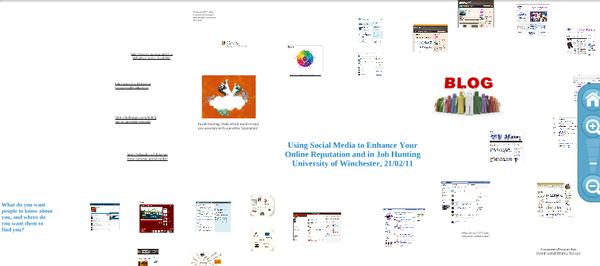
Social Media for Job Hunting
Shared with the World by Dr Bex Lewis
A Prezi designed for 'Employability Week' 2011, at the University of Wincester
Shared with the World by Dr Bex Lewis
Student information reading list
Shared with the World by Dr John Canning
A list of websites and publications concerning the information students use to choose a university.
Shared with the World by Dr John Canning
Preview |
Preview |
Transformational Teaching in the OpenLIVES Project
Shared with the World by Mr Antonio Martínez-Arboleda
Powerpoint presentation (in pdf and ppt) of the talk given by Miguel Arrebola and Antonio Martínez-Arboleda in the University of Southampton LLAS e-learning Symposium 2013 (25 January 2013).
Shared with the World by Mr Antonio Martínez-Arboleda
Preview |
Where next? Unlocking the potential of your philosophy degree - an employability guide
Shared with the World by Ms Danielle Lamb
A subject specific guide designed for philosophy students to help them identify and articulate how the skills that their degree is developing in them prepare them for the world of work.
Shared with the World by Ms Danielle Lamb
Preview |
Where next? Unlocking the potential of your theology or religious studies degree - an employability guide
Shared with the World by Ms Danielle Lamb
A subject specific guide designed for theology and religious studies students to help them identify and articulate how the skills that their degree is developing in them prepare them for the world of work.
Shared with the World by Ms Danielle Lamb


