Browse by Tags: archaeology
 | Up a level |
Number of items: 28.
Preview |
Archaeological Writing 1 Learning Object
Shared with the World by Dr Fiona Handley
This document contains an exercise which helps students understand how written work is structured, using an archaeological examples.
Shared with the World by Dr Fiona Handley
Preview |
Archaeological Writing 2 Learning Object
Shared with the World by Dr Fiona Handley
This document continues from Archaeological Writing 1, and gives students practice in organising the structure of a short written article, using an archaeology case study.
Shared with the World by Dr Fiona Handley
![[img]](http://www.humbox.ac.uk//1274/1/Dig_site.JPG)
 Preview |
Archaeology in Second Life Powerpoint
Shared with the World by Dr Fiona Handley
This powerpoint gives an overview of the range of archaeological materials that can be found in Second Life, the online virtual world that is increasingly being used as a learning space by educational organisations.
Shared with the World by Dr Fiona Handley
Preview |
Preview |
Archaeology: Athens, Empire and the Classical Greek World
Shared with the World by Dr Matt Phillpott
This IBL and associated powerpoint presentation was created for the Archaeology Department’s module, Athens, Empire and the Classical Greek World. This resource was produced with the help of CILASS (Centre for Inquiry-based Learning in the Arts and Social Sciences) at the University of Sheffield (see http://www.shef.ac.uk/cilass).
Shared with the World by Dr Matt Phillpott
Preview |
Preview |
Archaeology: Human Evolution and the Hominid Fossil Record
Shared with the World by Dr Matt Phillpott
This IBL was created for the Archaeology Department's third year students to investigate human evolution and the Hominid Fossil record. This resource was produced with the help of CILASS (Centre for Inquiry-based Learning in the Arts and Social Sciences) at the University of Sheffield (see http://www.shef.ac.uk/cilass).
Shared with the World by Dr Matt Phillpott

Archaeology@Southampton
Shared with the University by Alison Dickens
This collection showcases some of the resources collected by Archaeology teachers and researchers at the University of Southampton. They all relate to the excavation of the Roman site of Portus and contain images from an exhibition relating to the project.
Shared with the University by Alison Dickens
CILASS Case Studies (Centre for Inquiry-based Learning in the Arts and Social Sciences)
Shared with the World by Dr Matt Phillpott
These case studies showcase CILASS funded educational development projects undertaken at the University of Sheffield. These resources were produced with the help of CILASS (Centre for Inquiry-based Learning in the Arts and Social Sciences) at the University of Sheffield (see http://www.shef.ac.uk/cilass).
Shared with the World by Dr Matt Phillpott
Preview |
Choose your Own Adventure: Student-led Teaching in Large Lectures
Shared with the World by Mrs Lisa Lavender
A powerpoint presentation discussing how to use powerpoint hyperlinks within a lecture to enable the direction of the lecture to be led by student needs.
Shared with the World by Mrs Lisa Lavender
Preview |
Heritage Lesson Plan
Shared with the World by Dr Fiona Handley
This is a lesson plan for small group activities for either undergraduate or postgraduate students, to encourage them to think about the concept of heritage.
Shared with the World by Dr Fiona Handley
Preview |
Plagiarism Learning Object
Shared with the World by Dr Fiona Handley
This document presents a series of exercises that help students understand the concept of plagiarism, using case studies from archaeological publishing.
Shared with the World by Dr Fiona Handley
![[img]](http://www.humbox.ac.uk//style/images/fileicons/video.png)
![[img]](http://www.humbox.ac.uk//199/2/composite.jpg)
Polynomial Texture Mapping
Shared with the University by Dr Fiona Handley
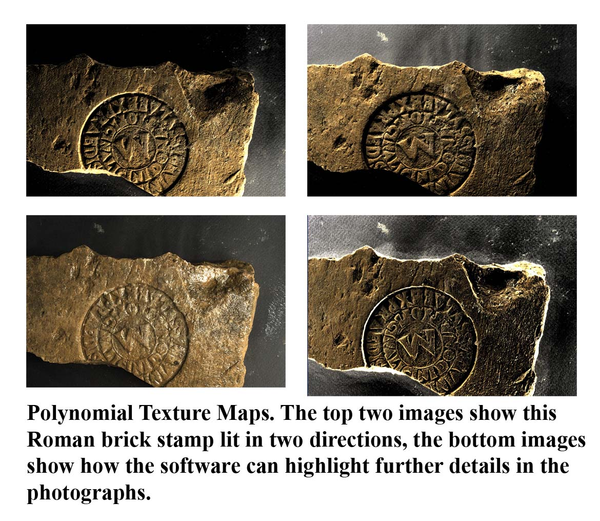
This resource consists of a short video demonstrating the use of a polynomial texture mapping rig, recording the surface features of a piece of inscribed stone, and an image which shows the how the different lighting sources and PTM software highlight tiny details in the stone surface.
Shared with the University by Dr Fiona Handley
![[img]](http://www.humbox.ac.uk//1457/1/composite.jpg)
 Preview |
Polynomial Texture Mapping - Examples of image results
Shared with the World by Dr Fiona Handley
These four images show how the same digital data set collected through polynomial texture mapping, can be modified in the PTM software to highlight different details in the lettering and surface texture on this Roman brick stamp.
Shared with the World by Dr Fiona Handley
Preview |
Portus Exhibition 1
Shared with the World by Dr Fiona Handley
A panel from an exhibition held at Southampton Museum and the British School at Rome on the University of Southampton's Portus project.
Shared with the World by Dr Fiona Handley
Preview |
Portus Exhibition 2
Shared with the World by Dr Fiona Handley
A panel from an exhibition held at Southampton Museum and the British School at Rome on the University of Southampton's Portus project
Shared with the World by Dr Fiona Handley
Preview |
Portus Exhibition 3
Shared with the World by Dr Fiona Handley
A panel from an exhibition held at Southampton Museum and the British School at Rome on the University of Southampton's Portus project.
Shared with the World by Dr Fiona Handley
Preview |
Portus Exhibition 4
Shared with the World by Dr Fiona Handley
A panel from an exhibition held at Southampton Museum and the British School at Rome on the University of Southampton's Portus project.
Shared with the World by Dr Fiona Handley
Preview |
Portus Exhibition 5
Shared with the World by Dr Fiona Handley
A panel from an exhibition held at Southampton Museum and the British School at Rome on the University of Southampton's Portus project
Shared with the World by Dr Fiona Handley
Preview |
Portus Exhibition 6
Shared with the World by Dr Fiona Handley
A panel from an exhibition held at Southampton Museum and the British School at Rome on the University of Southampton's Portus project
Shared with the World by Dr Fiona Handley
Preview |
Portus Exhibition 7
Shared with the World by Dr Fiona Handley
A panel from an exhibition held at Southampton Museum and the British School at Rome on the University of Southampton's Portus project
Shared with the World by Dr Fiona Handley
Preview |
Portus Video
Shared with the World by Dr Fiona Handley
This video describes some of the archaeological fieldwork that has been taking place at the University of Southampton and University of Cambridge's excavations at Portus, the main port of ancient Rome.
Shared with the World by Dr Fiona Handley
Preview |
Recording Objects Learning Object
Shared with the World by Dr Fiona Handley
This document contains a series of exercises which help archaeology students understand some of the important points in recording archaeological objects.
Shared with the World by Dr Fiona Handley
Preview |
Statistics for the humanities
Shared with the World by Dr John Canning
Statistics for the Humanities is now available as an open access e-book (PDF format only at present).
The book is aimed primarily at undergraduate humanities students, especially those who have not studied mathematics since the age of 16.
Shared with the World by Dr John Canning
Preview |
Using Fieldwork Data Learning Object
Shared with the World by Dr Fiona Handley
This document contains a series of exercises that demonstrate how material from fieldwork such as visual, numeric and survey data should be used as evidence in supporting writing.
Shared with the World by Dr Fiona Handley
Video Exavating and processing archaeological objects at the Roman site of Portus
Shared with the University by Dr Fiona Handley
A short video covering the excavation of objects, showing bags of environmental samples, and the sorting and processing of finds from the Roman site of Portus in Italy.
Shared with the University by Dr Fiona Handley
What Do Bones Say About Beliefs?
Shared with the World by Dr Suzanne Pilaar Birch
This 4 minute video talks about different human burial customs through time and shows us what we can learn about the transition to farming in south-eastern Europe by looking at changes and continuity of burial practices through time.
Shared with the World by Dr Suzanne Pilaar Birch
Where Did Humans Go in the Last Ice Age?
Shared with the World by Dr Suzanne Pilaar Birch
This 4 minute video explores where humans living in Europe during the last ice age moved to, and uses zooarchaeology (the study of animal bones) to reconstruct site use and past diet.
Shared with the World by Dr Suzanne Pilaar Birch


